
Every organization has a value proposition — a reason customers, members, or stakeholders choose them over the alternatives. But when you ask a leadership team to articulate theirs clearly, the conversation stalls fast.
People default to describing what they do instead of why it matters. They list features instead of outcomes. They use internal language that means nothing to the people they’re trying to reach. And because everyone on the team sees the organization from a slightly different angle, you end up with five versions of the value proposition and no alignment on which one is right.
That’s where the Value Proposition Canvas comes in — and where facilitation makes the difference.
What Is the Value Proposition Canvas?
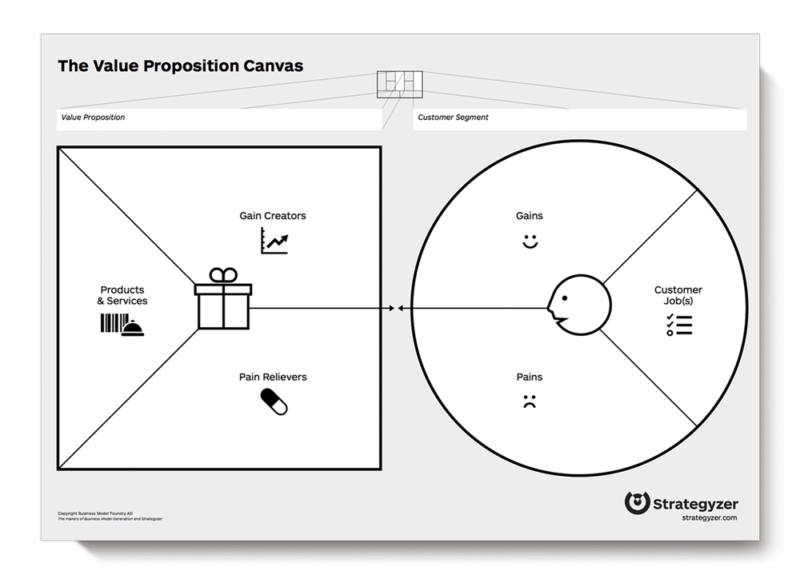
Developed by Alex Osterwalder and Yves Pigneur, the creators of the Business Model Canvas, the Value Proposition Canvas (VPC) is a visual framework that helps organizations align what they offer with what their customers or stakeholders actually need.
It’s built around two sides:
The Customer Profile breaks down your target audience into three areas. Customer Jobs are the tasks, problems, or needs your customers are trying to address — and they come in three types. Functional jobs are the practical tasks customers need to accomplish (getting a report delivered, processing a transaction). Social jobs relate to how customers want to be perceived by others (being seen as innovative, being recognized as a trusted partner). Emotional jobs are about how customers want to feel (confidence in a decision, peace of mind that a problem is handled). Most teams think only about functional jobs and miss the social and emotional drivers entirely — which is often where the real differentiation lives.
Pains are the negative experiences, risks, or frustrations customers encounter while trying to get those jobs done. Gains are the outcomes and benefits they’re looking for.
The Value Map mirrors the customer profile with your organization’s response. Products and Services are what you offer. Pain Relievers describe how your offerings address specific customer frustrations. Gain Creators explain how you deliver the outcomes customers want.
Not all jobs, pains, and gains carry equal weight. A critical step in the VPC process is ranking them — which customer jobs matter most, which pains are most severe, which gains are most desired. This prioritization is where the real strategic value emerges, and it’s also where teams tend to disagree most.
The goal is achieving what Strategyzer calls fit — making sure the most important elements of your Value Map directly address the most important elements of your Customer Profile. When you have fit, your value proposition is clear, defensible, and actionable. When you don’t, you’re guessing.
One important note: the canvas is not a finished answer. It’s a set of hypotheses about what your customers value and how you deliver on it. The strongest organizations treat their VPC as a starting point — then test those assumptions with real customers, members, or stakeholders to validate whether the fit they’ve mapped on paper holds up in practice.
Where Value Proposition Work Shows Up
Value proposition work can take different forms depending on the organization and the situation.
Sometimes it’s a standalone engagement. An organization comes to us specifically because they know their positioning needs work — maybe the market has shifted, their membership has changed, or they’re launching something new and need to articulate why it matters. A dedicated value proposition session gives the team focused time to do that work properly using the VPC framework.
Other times it’s embedded in a larger engagement. In a recent strategic planning engagement for a national association, we built value proposition refinement into the retreat agenda as a dedicated working session. The association needed to sharpen its articulation of member value before moving into goals and strategies — and that clarity strengthened everything that followed. That’s not always the right sequence for every organization, but for this team it made a significant difference.
The common thread is that most organizations haven’t done this work with the rigor it deserves. They have a general sense of their value, but they haven’t pressure-tested it as a team with a structured framework.
Why This Benefits From Facilitation
The Value Proposition Canvas is simple to understand. It’s not simple to do well — especially when you’re evaluating your own organization.
You’re too close to it. Internal teams have years of assumptions baked into how they describe their value. A facilitator brings the outside perspective to challenge those assumptions — to ask “is that really what your customers value, or is that what you wish they valued?”
The conversation gets stuck. Without structure, value proposition discussions become circular. People talk past each other. The loudest voice anchors the conversation around their version. A facilitator keeps the process moving and makes sure every perspective is heard before the team converges.
Prioritization is where teams clash. Filling in the canvas is the easy part. Ranking what matters most — which customer jobs are highest priority, which pains are most severe, which gains matter most — is where real disagreement surfaces. The sales team sees one thing, operations sees another, leadership sees a third. A facilitator manages that tension productively so the team lands on priorities they all own, not a compromise nobody believes in.
Honesty is hard without a neutral party. Sometimes the truth is that your value proposition has eroded — competitors caught up, the market shifted, or what used to differentiate you is now table stakes. That’s a difficult conversation for a leadership team to have with themselves. A neutral facilitator can surface those realities without it feeling like an attack.
Alignment requires structured process. The VPC gives you the framework. Facilitation gives you the process to work through it as a team — so you leave with a value proposition everyone understands, believes in, and can articulate consistently.
Getting Started
Whether you need to build a value proposition from scratch, refine one that’s gone stale, or pressure-test your positioning before a strategic planning process, a facilitated session gives your team the structure and outside perspective to get it right.
If your organization is asking “why do our customers choose us?” and getting different answers from different people, that’s the signal. Let’s talk about it.


Comments are closed.